Sunday, October 15, 2006

pictures from Miramar airshow


Refueling.


A DC-3 owned by Hiller Aviation Museum in San Carlos. Fuel consumption at cruise: 1.5 gallons per minute.


The Blue Angels do their thing. (Photo by Coppertop.)


Look closely at what's hanging from that rope.

Posted by Picasa

Friday, October 13, 2006

more biking adventures

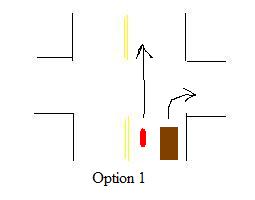
I got back on the bike today for a ride got told to "get out of the middle of the road!" Some visual aids may help here. We were at an intersection. I, the red oval, was near the double yellow, and the yelling gentleman in the big brown box was on the right, with his right turn signal on. See "Option 1":
Why do I call it "Option 1"? Because I have a choice about where to put the bike at an intersection with a stop sign and, if I'm going straight, I usually use Option 1. After all, if there's cross traffic the car behind me can't get through any faster than I can. And, more importantly, it prevents exactly the situation that the gentleman in question was trying to create, namely Option 2:Let's see--you'd like me to be on the right so you can turn right and cut me off? Um, no thanks.

I saw Critical Mass tying up Hillcrest traffic last month. At this point, about all I can say is more power to 'em and bring on the $5 gas.

Tuesday, October 10, 2006

what the Military Commissions Act may mean for citizens

I've been wondering about something odd in the structure of the Military Commissions Act: it defines "unlawful enemy combatant" and "alien" separately in § 948a but then says military commissions have jurisdiction only over alien unlawful military combatants in § 948c.

I'm beginning to think the key might be Hamdi v. Rumsfeld. During the invasion of Afghanistan, the U.S. government detained Yaser Esam Hamdi. After learning he was a U.S. citizen, it transferred him from Guantanamo to a brig in Virginia, where it held him without bringing charges. In Hamdi v. Rumsfeld, the Supreme Court held that "a citizen-detainee seeking to challenge his classification as an enemy combatant must receive notice of the factual basis for his classification, and a fair opportunity to rebut the Government's factual assertions before a neutral decisionmaker." (More or less. It's a fractured decision, and two members of the plurality are no longer on the Court, so you have to count some noses.)

I haven't gone trolling through the Congressional Record for it, but perhaps Congress intends the "Combatant Status Review Tribunal or another competent tribunal established under the authority of the President or the Secretary of Defense" from § 948a(1)(ii) to be the "neutral decsionmaker" the Court requires for U.S. citizens.

Sunday, October 08, 2006

reacting to neutrality and apathy

"Whoever is not with us is against us" came from a speech Lenin delivered in 1920. According to CNN, President Bush actually said, "You're either with us or against us in the fight against terror." In an e-mail exchange with someone on the other end of the political spectrum from Mr. Bush, discussing the attitudes of non-conservative Christians, that person said "personally I believe they are complicit if they don't take a stand."

If you draw a circle and define those outside it as the enemy, you can create a siege mentality and unify your power base. But the price for the tactic is high: it allows no room for neutrality and risks alienating those not yet aware of the conflict who have not even taken a stand.

There is also sort of arrogance in this approach. Note the underlying assumption that the speaker's issue, whatever it might be, is so important that the entire world must know and care about it to the same degree that the speaker does.

What's the alternative? How about "whoever is not against us is for us"? (Mark 9:40) Or at least recognizing that there might be people in the world who are busy enough with with their own problems that they're not ready to adopt a new one.

Saturday, October 07, 2006

thinking like a lawyer vs. thinking like an engineer

Coppertop asked me yesterday what it means to "think like a lawyer" and how it's different from thinking like an engineer. There's a good start on what it means to think like a lawyer here, but it doesn't make clear how the precise thinking a lawyer does is different from the precise thinking an engineer does. It's taken a day of pondering and sleeping on the question, but I think I have the answer. From what I've been able to tell so far, in law, it's more important to keep the peace than it is to reach an ultimately just result, while in engineering it's more important to reach a "good enough" result than it is to get there the "correct" way. Everything else follows from that difference.

Let's start with law. That's a pretty controversial assertion: justice isn't what it's all about? Consider the idea of precedent, that one court will often defer to the decision of an earlier one, even if it disagrees in this particular case.[1] One important reason for doing that is predictability. You can't have the Rule of Law unless people know what the law is, and you can't know what the law is if it changes every time a new court looks at it. So we're willing to accept results that might not be perfectly equitable in a particular case so as to keep the peace in general.

If law is more about keeping the peace than about justice, what does that mean for legal reasoning? It means legal reasoning is not a search for the truth, it's a form of persuasion designed to convince the reader that a particular result is the proper one. Lawyers for both sides look at essentially the same facts and cases and write "tightly reasoned" legal briefs coming to completely opposite conclusions in order to convince the judge their conclusion is the right one. Similarly, judges write opinions designed to convince other judges, and ultimately the public, that their conclusions are correct.

How does legal reasoning work to convince people? Every argument proceeds in steps. Between the steps, there's some play in the joints. The more joints, the more play you have, and by adding just a little bit of adjustment at each joint, or by adding or removing a joint here or there, you can shift where the argument ends up. In general, it's very process oriented. I believe that's also why lawyers are so in love with citations, not because they help to reach a more correct result, but because they lend credibility to the reasoning process if other people have reasoned the same way at the point in the argument.

Thinking like an engineer is different. Engineers care about reaching the ultimate result. Does the spar carry the design load? Does the software run quickly enough? Their goal is to meet the design criteria for a problem--the wing must lift an X pound airplane while weighing no more than Y pounds itself--with an additional safety margin. It's much less important how you get there. Years ago, I was working with an applied physicist in an electronics lab building an amplifier. He'd calculated exactly the resistance value we needed and was going through an entire drawer of resistors, one by one, measuring the slight variations of each to find one that would match the value he'd calculated. My answer was to find a variable resistor, drop it in the circuit, hook up an oscilloscope, and adjust the resistor until it looked about right. It was a cheap kludge, but it got us to a working amplifier that met the spec and let us go home for the weekend. And that's a common engineering approach: use the theory, which is often only approximate, to get you close, then use your instincts to fudge things from there until the universe says you have it about right.

That's not to say that an engineer doesn't have to think precisely. Like a lawyer, a software engineer must decompose a problem into smaller and smaller pieces until the individual pieces are small enough to solve. In a piece of software the size of an operating system, that decomposition can proceed mighty far indeed, and a single misplaced character can bring the whole edifice crashing down. The difference is the focus: the engineer lets the goal drive the decomposition[2], while for the lawyer the decomposition itself must persuade the reader that the end result is the correct one.

[1] Apologies to the lawyerly types for being horribly sloppy here, rolling binding precedent, persuasive precedent, stare decisis, standards of review, and various forms of estoppel into one big ball. Suffice to say it's something that discourages one court from distinguishing, overruling, or reversing the decision of another.

[2] And here's where the software engineers get upset. There are other constrains on the decomposition, the most important being that it must be "maintainable", which is a fancy way of saying legible enough for another engineer to understand, and well enough organized that it's possible to make changes without introducing a whole bunch of bugs.

Monday, October 02, 2006

book links Phillip Morris to global warming disinformation campaign

Here's a fascinating exerpt from a book by a Guardian reporter which uses court documents from tobacco litigation to link Phillip Morris with the disinformation campaign about global warming:
[Phillip Morris's public relations agency] APCO warned that: "No matter how strong the arguments, industry spokespeople are, in and of themselves, not always credible or appropriate messengers."

So the fight against a ban on passive smoking had to be associated with other people and other issues. Philip Morris, APCO said, needed to create the impression of a "grassroots" movement - one that had been formed spontaneously by concerned citizens to fight "overregulation". It should portray the danger of tobacco smoke as just one "unfounded fear" among others, such as concerns about pesticides and cellphones. APCO proposed to set up "a national coalition intended to educate the media, public officials and the public about the dangers of 'junk science'. Coalition will address credibility of government's scientific studies, risk-assessment techniques and misuse of tax dollars ... Upon formation of Coalition, key leaders will begin media outreach, eg editorial board tours, opinion articles, and brief elected officials in selected states."
The excerpt also discusses Exxon's role in the campaign. You may remember I wrote about their hiring Philip Cooney. According to the book, which uses data from ExxonSecrets.org, they also fund JunkScience.com and a number of organizations.

The book is Heat, by George Monbriot.

Military Commissions Act goes to whitehouse

The Senate and the House have agreed on a version of the bill. House's vote's here.

Relevant passages from the version the Whitehouse is getting:
(1) UNLAWFUL ENEMY COMBATANT- (A) The term `unlawful enemy combatant' means--
(i) a person who has engaged in hostilities or who has purposefully and materially supported hostilities against the United States or its co-belligerents who is not a lawful enemy combatant (including a person who is part of the Taliban, al Qaeda, or associated forces); or
(ii) a person who, before, on, or after the date of the enactment of the Military Commissions Act of 2006, has been determined to be an unlawful enemy combatant by a Combatant Status Review Tribunal or another competent tribunal established under the authority of the President or the Secretary of Defense.
§ 948a(1). So the President has the power to declare people enemy combatants. It looks like § 950g gives the D.C. Circuit Court of Appeals jurisdiction to hear appeals, and the Supreme Court after that, so at least there's some judicial oversight. However,
(b) Standard for Review- In a case reviewed by it under this section, the Court of Appeals may act only with respect to matters of law.
(c) Scope of Review- The jurisdiction of the Court of Appeals on an appeal under subsection (a) shall be limited to the consideration of--
(1) whether the final decision was consistent with the standards and procedures specified in this chapter; and
(2) to the extent applicable, the Constitution and the laws of the United States.
§ 950g. Beyond that,
(a) Finality- The appellate review of records of trial provided by this chapter . . . are final and conclusive. Orders publishing the proceedings of military commissions under this chapter are binding upon all departments, courts, agencies, and officers of the United States, except as otherwise provided by the President.
(b) Provisions of Chapter Sole Basis for Review of Military Commission Procedures and Actions- Except as otherwise provided in this chapter and notwithstanding any other provision of law (including . . . any . . . habeas corpus provision), no court, justice, or judge shall have jurisdiction to hear or consider any claim or cause of action whatsoever . . . relating to the prosecution, trial, or judgment of a military commission under this chapter, including challenges to the lawfulness of procedures of military commissions under this chapter.
§ 950j. The bottom line? Avoid being wrongfully accused.