Monday, October 02, 2006

Military Commissions Act goes to whitehouse

The Senate and the House have agreed on a version of the bill. House's vote's here.

Relevant passages from the version the Whitehouse is getting:
(1) UNLAWFUL ENEMY COMBATANT- (A) The term `unlawful enemy combatant' means--
(i) a person who has engaged in hostilities or who has purposefully and materially supported hostilities against the United States or its co-belligerents who is not a lawful enemy combatant (including a person who is part of the Taliban, al Qaeda, or associated forces); or
(ii) a person who, before, on, or after the date of the enactment of the Military Commissions Act of 2006, has been determined to be an unlawful enemy combatant by a Combatant Status Review Tribunal or another competent tribunal established under the authority of the President or the Secretary of Defense.
§ 948a(1). So the President has the power to declare people enemy combatants. It looks like § 950g gives the D.C. Circuit Court of Appeals jurisdiction to hear appeals, and the Supreme Court after that, so at least there's some judicial oversight. However,
(b) Standard for Review- In a case reviewed by it under this section, the Court of Appeals may act only with respect to matters of law.
(c) Scope of Review- The jurisdiction of the Court of Appeals on an appeal under subsection (a) shall be limited to the consideration of--
(1) whether the final decision was consistent with the standards and procedures specified in this chapter; and
(2) to the extent applicable, the Constitution and the laws of the United States.
§ 950g. Beyond that,
(a) Finality- The appellate review of records of trial provided by this chapter . . . are final and conclusive. Orders publishing the proceedings of military commissions under this chapter are binding upon all departments, courts, agencies, and officers of the United States, except as otherwise provided by the President.
(b) Provisions of Chapter Sole Basis for Review of Military Commission Procedures and Actions- Except as otherwise provided in this chapter and notwithstanding any other provision of law (including . . . any . . . habeas corpus provision), no court, justice, or judge shall have jurisdiction to hear or consider any claim or cause of action whatsoever . . . relating to the prosecution, trial, or judgment of a military commission under this chapter, including challenges to the lawfulness of procedures of military commissions under this chapter.
§ 950j. The bottom line? Avoid being wrongfully accused.

Friday, September 29, 2006

the senate's version of the bill

The Senate's version of the Military Commissions Act of 2006, which it passed yesterday, is S.3930. I don't have time this morning to do a full analysis, but a quick check of the definitions section, § 948a, seems to show it does not allow a Presidentially-appointed commission to declare someone an enemy combatant:
(3) LAWFUL ENEMY COMBATANT- The term `lawful enemy combatant' means an individual who is--

(A) a member of the regular forces of a State party engaged in hostilities against the United States;

(B) a member of a militia, volunteer corps, or organized resistance movement belonging to a State party engaged in such hostilities, which are under responsible command, wear a fixed distinctive sign recognizable at a distance, carry their arms openly, and abide by the law of war; or

(C) a member of a regular armed force who professes allegiance to a government engaged in such hostilities, but not recognized by the United States.

(4) UNLAWFUL ENEMY COMBATANT- The term `unlawful enemy combatant' means an individual engaged in hostilities against the United States who is not a lawful enemy combatant.
That's good. It appears to me that the House's version would let a President use it to target political opponents. (Not necessarily this President. Remember that legislation tends to stick around. Think back over the last 50-70 years of Presidents, and project forward that same time span. Are there none that might succumb to the temptation?) Though I might have missed a jurisdictional provision somewhere in there.

On the other hand, the Senate version still denies the Geneva Conventions to alien unlawful enemy combatants (§ 948b(f)) and includes similar handling of confidential information (§ 948j(b)).

You can find out how your Senator voted on the bill here. (Both California Senators voted against it.) The corresponding roll-call vote for the House version is here.

At this point, we'll see what happens once they reconcile the two bills.

Thursday, September 28, 2006

the terrorist tribunal bill

The House has passed H.R. 6166, the Military Commissions Act of 2006, which they intend to establish tribunals to try unlawful enemy combatants. The bill defines "unlawful enemy combatant" in § 948a:
(1) UNLAWFUL ENEMY COMBATANT-

(A) The term `unlawful enemy combatant' means--

(i) a person who has engaged in hostilities or who has purposefully and materially supported hostilities against the United States or its co-belligerents who is not a lawful enemy combatant (including a person who is part of the Taliban, al Qaeda, or associated forces); or

(ii) a person who, before, on, or after the date of the enactment of the Military Commissions Act of 2006, has been determined to be an unlawful enemy combatant by a Combatant Status Review Tribunal or another competent tribunal established under the authority of the President or the Secretary of Defense.
The bill defines "Lawful Enemy Combatant" this way:
(2) LAWFUL ENEMY COMBATANT- The term `lawful enemy combatant' means a person who is--

(A) a member of the regular forces of a State party engaged in hostilities against the United States;

(B) a member of a militia, volunteer corps, or organized resistance movement belonging to a State party engaged in such hostilities, which are under responsible command, wear a fixed distinctive sign recognizable at a distance, carry their arms openly, and abide by the law of war; or

(C) a member of a regular armed force who professes allegiance to a government engaged in such hostilities, but not recognized by the United States.
As far as I can tell, § 948a(A)(1)(i) would include the Minutemen of the American Revolution. I guess that's some sort of vindication for the British forces that accused the U.S. of not honoring the rules of war in 1776.

Note the odd split in who gets to decide who's an enemy combatant. § 948a(A)(1)(i) gives a statutory definition, so that'd probably fall to the courts to interpret and figure out the dividing line. However, § 948a)(A)(1)(ii) lets an executive-branch commission opt-in anyone else it wants to, even if they're not involved in hostilities and, apparently, even if they're U.S. citizens.

Once you're in the system, you enter court-martial land. Furthermore, non-citizens in the system can't use the Geneva Conventions:
§ 948b(g): Geneva Conventions Not Establishing Source of Rights- No alien unlawful enemy combatant subject to trial by military commission under this chapter may invoke the Geneva Conventions as a source of rights.
I don't have the several hours it'd take to go through the bill in detail, but it contains several other provisions that are worth thinking very seriously about before we subject ourselves to them. For example, you can use hearsay evidence ("I heard John say Jane said this..."):
(E)(i) Except as provided in clause (ii), hearsay evidence not otherwise admissible under the rules of evidence applicable in trial by general courts-martial may be admitted in a trial by military commission if the proponent of the evidence makes known to the adverse party, sufficiently in advance to provide the adverse party with a fair opportunity to meet the evidence, the intention of the proponent to offer the evidence, and the particulars of the evidence (including information on the general circumstances under which the evidence was obtained). The disclosure of evidence under the preceding sentence is subject to the requirements and limitations applicable to the disclosure of classified information in section 949j(c) of this title.

(ii) Hearsay evidence not otherwise admissible under the rules of evidence applicable in trial by general courts-martial shall not be admitted in a trial by military commission if the party opposing the admission of the evidence demonstrates that the evidence is unreliable or lacking in probative value.
Finally, the bill treats classified evidence like this in § 949j:
(c) Protection of Classified Information-

(1) With respect to the discovery obligations of trial counsel under this section, the military judge, upon motion of trial counsel, shall authorize, to the extent practicable--

(A) the deletion of specified items of classified information from documents to be made available to the accused;

(B) the substitution of a portion or summary of the information for such classified documents; or

(C) the substitution of a statement admitting relevant facts that the classified information would tend to prove.

(2) The military judge, upon motion of trial counsel, shall authorize trial counsel, in the course of complying with discovery obligations under this section, to protect from disclosure the sources, methods, or activities by which the United States acquired evidence if the military judge finds that the sources, methods, or activities by which the United States acquired such evidence are classified. The military judge may require trial counsel to provide, to the extent practicable, an unclassified summary of the sources, methods, or activities by which the United States acquired such evidence.

(d) Exculpatory Evidence-

(1) As soon as practicable, trial counsel shall disclose to the defense the existence of any evidence known to trial counsel that reasonably tends to exculpate the accused. Where exculpatory evidence is classified, the accused shall be provided with an adequate substitute in accordance with the procedures under subsection (c).

(2) In this subsection, the term `evidence known to trial counsel', in the case of exculpatory evidence, means exculpatory evidence that the prosecution would be required to disclose in a trial by general court-martial under chapter 47 of this title.
A couple quick questions come to mind with this provision. First, what sort of incentive does it create for trial counsel to learn about exculpatory evidence. Second, what provisions exist to review the decision to disclose, or not to disclose, that evidence.

Wednesday, September 27, 2006

Gentlemen, this is the EM-50 Urban Assault Vehicle

Car names can tell us about ourselves. They're a sort of fun-house mirror for our culture. Ford's got the Explorer, Excursion, and Escape, so you can pretend you're driving across the savanna on your way to buy milk and oreos. Cadillac appropriately named its entry in the escalating land yacht arms race the Escalade. But Nissan, oh Nissan, their names say much. Remember when they were Datsun, pumping out little econoboxes? Not any more. A couple days ago, I looked over at the behemoth parking next to me and it was a Nissan Titan. Then, just today, a Nissan Armada muscled past. (I guess you need an Armada for those times a lone land yacht just won't do?) Leave it to a company from another culture to cut to the chase: forget the fake "take a trip" names, and just name them after big things.

adventures in swimming

The stress of school can do nasty things to a body. As a result, I've been wanting to get back in shape. Ever since the bicycle incident, the concensus around the family is that I oughtn't to be biking to school. (I've even been informally concensed that I oughtn't to be biking to the grocery store either, but we'll see if that lasts. I'm mighty partial to two wheels.)

Anyway, today I tried Plan B: attend the masters' swim. Near as I can tell, the masters' swim is a mix of people who used to be on swim teams or just plain got bored of swimming classes and get together to swim various combinations of going back and forth across the pool. Cool, I can handle that. Unlike my little sis, I was never a super good swimmer, but I grew up around the water and can usually hold my own against someone who's not on a swim team.

'Twas not an auspicious beginning. Now, I know I'm out of shape, but my body apparently felt that reminding me through the usual out-of-breath and pounding heart just wasn't going to cut it. Part way through I started getting leg cramps. I could massage them out but they kept coming back, which pretty much shut down the rest of today's practice. Guess I need to work up to this stuff.

We'll see how long this attempt lasts. In the past, it hasn't been too long. In fact, the last time I was swimming in a master's class, mid-way through a 1600 free I realized I could be spending that time building an airplane instead, and that's pretty much where the airplane project started and the swimming project ended.

Plan C is to talk Coppertop into salsa dancing.

Thursday, September 21, 2006

changes in arctic ice sheet

The European Space Agency has reported that, for the first time on record, enough arctic ice shifted and melted in August that a ship could sail to the North Pole. You can see a somewhat less technical, but perhaps clearer, version of the article here. The article quotes Mark Drinkwater, director of the ESA's Ocean/Ice unit, as saying

This situation is unlike anything observed in previous record low ice seasons. It is highly imaginable that a ship could have passed from Spitzbergen or Northern Siberia through what is normally pack ice to reach the North Pole without difficulty.

If this anomaly trend continues, the North-East Passage or ‘Northern Sea Route’ between Europe and Asia will be open over longer intervals of time, and it is conceivable we might see attempts at sailing around the world directly across the summer Arctic Ocean within the next 10-20 years.

Not entirely uncoincidentally, the October Scientific American has an article that looks at how mass extinctions in the past might have happened. While it's commonly accepted that an asteroid or comet impact killed the dinosaurs, the details for earlier mass extinctions are fuzzier. The gist of this article is that, once atmospheric carbon dioxide reaches around 1000 ppm or so, anaerobic bacteria in the oceans begin bubbling up large quantities of hydrogen sulfide gas, killing things both in the ocean and on land. The models predict that the situation eventually stabilizes and returns to normal after a few hundred thousand or million years.[1] If current carbon dioxide growth rates continue without change, we should hit the 1000 ppm number some time around the year 2200.

[1] The problem with numbers in the hundreds of thousands of years range is it's very hard to conceive of what they mean in human timescales. If we assume agriculture developed around, say, 12000 BCE, and round off for convenience to 15,000 years, in a 100,000 year time-span you could go from discovering agriculture to learning how to form a civilization to inventing writing to walking on the moon and jamming on iPods a little over six times. In a million years, you could do it 67 times, give or take a dark age.

Wednesday, September 20, 2006

working on the airplane rudder

I haven't posted an airplane update in a while, largely because I haven't had time to work on it in a while. Just before the move, the rudder, which I'd hung on the wall to get it out of the way, made a leap for freedom. It crunched the trailing edge pretty well.

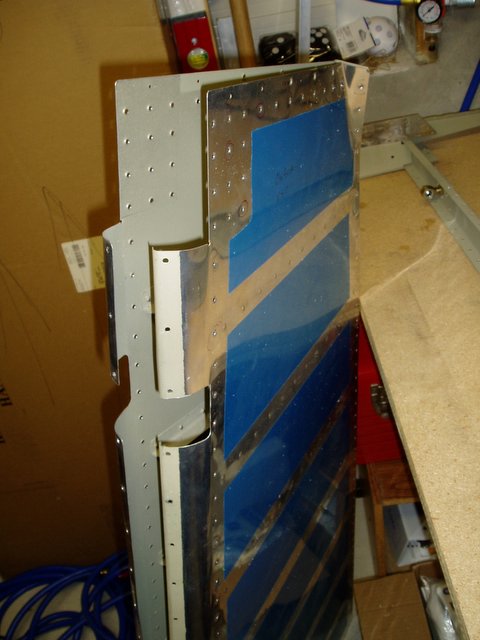
I've been working backwards, in a way, drilling out the rivets to salvage the intact parts and replace the damaged ones. Unfortunately, with this rudder design, the intact parts aren't a whole lot. Here's a photo of the skeleton, which is most of what's salvageable.
Here, you can see the damaged part. The damage itself is to the right: that part that's bent towards the camera shouldn't be. Both rudder skins and the wedge that holds them together got bent. There are several stiffeners attached to the skin (you can't see them in this view) that didn't actually get bent, but drilling them out and trying to reuse them would likely damage them, so I expect to simply get new ones when I order new skins.

Anyway, the next step with the rudder will be to order new pieces and begin rebuilding, which is a bit of a discouraging prospect. I'll probably start on the elevator instead and, when I make the inevitable goof and have to get a replacement part, have them ship rudder parts at the same time. Posted by Picasa